
Last screening: virtual-assistant scored 58/100, 2 days ago · see a sample record
Screening software for small teams
Screen overseas candidates yourself — with the questions already written
Every other screening tool hands you an empty box and asks you to invent good questions for a job you have never hired for. Type “Bookkeeper” and you get the month-end discrepancy scenario, a work sample you can actually read, and the real pay band. Post a role, share one link, and judge the answers. Free for one role, no card, no sales call.
- Free to start — no card
- Never charged per candidate
- Cancel any time, keep your data
In fifteen seconds
The whole thing, in three screens
These are screenshots of a real role, posted on the free plan, answered by real applicants.
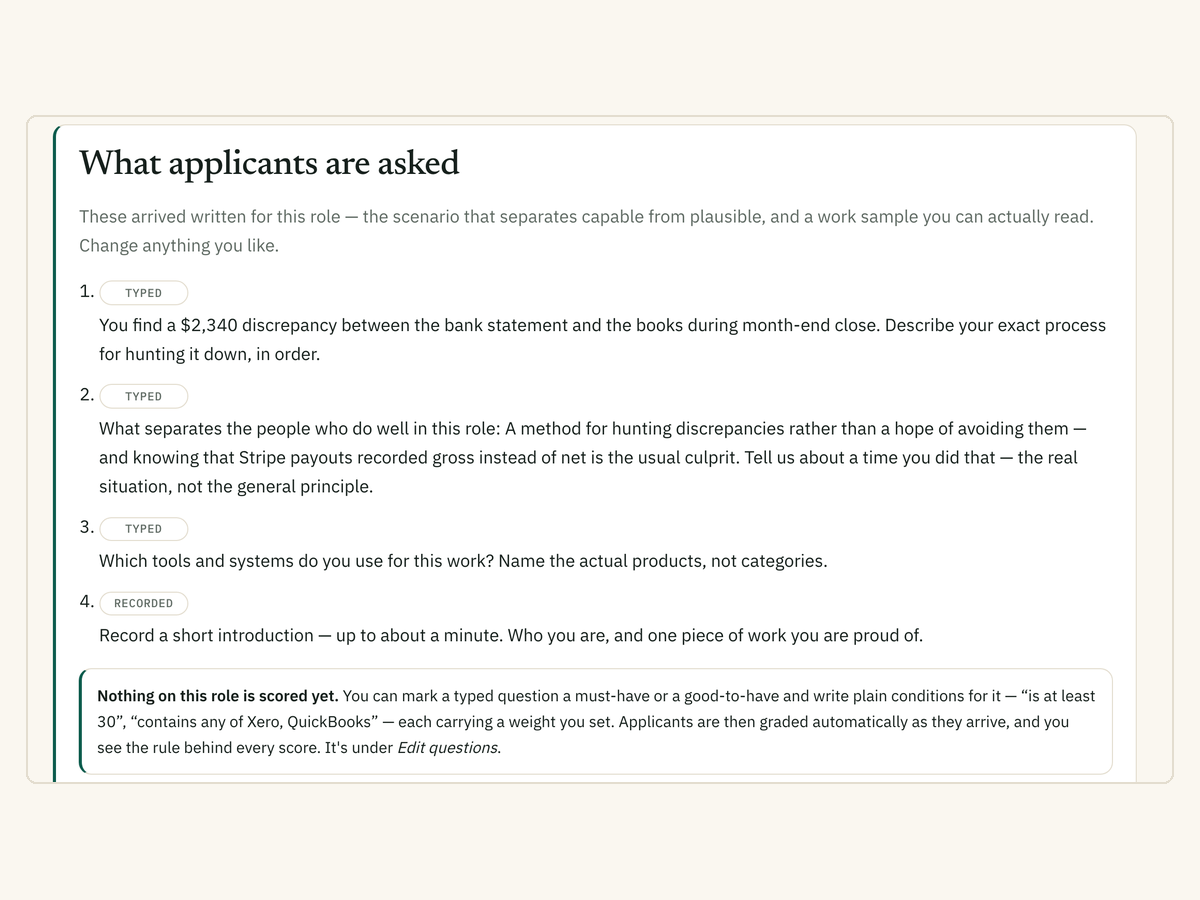
1 · Post the role. Type the job title. For 24 common roles the screening questions arrive already written — the scenario that separates a capable bookkeeper from a plausible one, and a work sample you can read. You get a link to share in about thirty seconds. 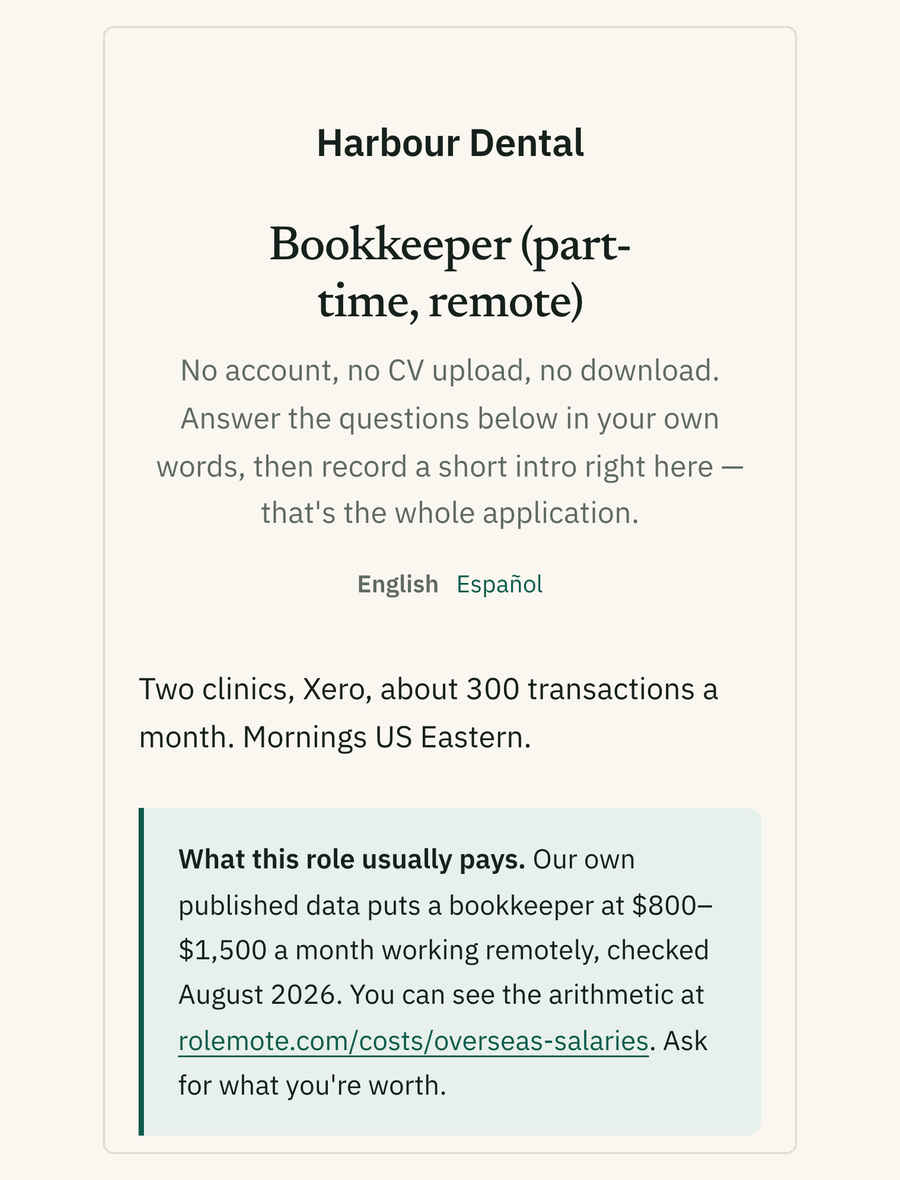
2 · They answer on one link. No account, no CV upload, no download, nothing to schedule. They type, record a video or voice note, or attach a file — on a phone, in their own time. Your company name is on the page, not ours. 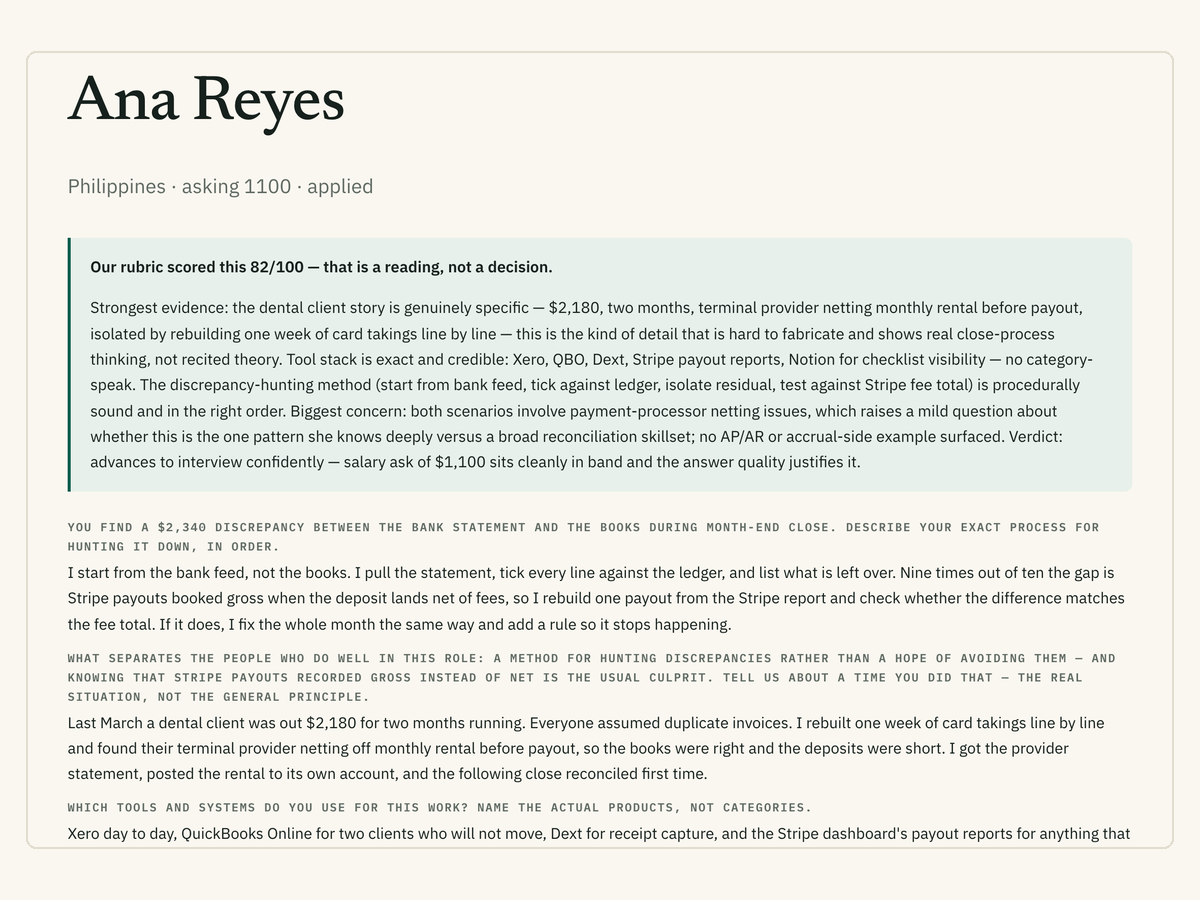
3 · You read and decide. Every answer sits under the question that asked it, scored against conditions you set. Nothing is rejected on its own — every decision waits for a person, and that person is you.


Don't take "rigorous vetting" on faith — run it yourself
The same rubric that grades your applicants is live on this site — point it at yourself. Answer a real scenario question and read the score and the notes it writes, before you ask anyone else to.
Before you read any further
We are new, and we have no customer logos. Here is what to do about that.
No case studies, no testimonials, and we are not going to manufacture any. Other screening tools have years of proof, and our comparison pages name them, including where they beat us outright. What we have instead is that the free plan is not a demo: post a real role, take as many applicants as turn up, read every answer and hire someone, without a card and without talking to us. If the questions we wrote are no good, you will know within a day — and you will not have paid for the privilege.
See where competitors beat us →What you'd actually be paying for →
Free for one role. $49 when you need more.
The free plan runs one open role end to end, with no cap on applicants and no card. Paid plans open more roles at once and keep watching after you hire — a short monthly check-in with both sides. Solo $49, Team $99, Agency $249 a month, cancel from inside the product.
Not just the Philippines — five talent markets
Pick for cost, for real US-timezone overlap, or for a native-English voice. We source across all five and screen them exactly the same way.
Philippines
Evening / async shift · UTC+8
The deepest, most affordable pool — support, admin, bookkeeping. English is an official language.
Hiring guide →Colombia
Full US-hours overlap
Bogotá runs US Central time all year — live collaboration with no antisocial hours.
Hiring guide →Mexico
Your timezone, next door
Same or near-same hours as most of the US, and close enough for the occasional visit.
Hiring guide →South Africa
US-morning overlap · UTC+2
Native English with a neutral accent — the pick for phone, voice, and executive support.
Hiring guide →Argentina
US-afternoon overlap · UTC−3
Deep senior technical and creative talent — developers, designers, and marketers.
Hiring guide →What the hire itself costs
Before the software question there is a money question: what does this person cost in each market? Pick a role and a country. Every number is our own sourced data — no marketing math.
Salary bands are our sourced editorial figures × a stated country factor. What an agency would charge to find this person is on the agency fee page.
Get a free hiring brief for an executive assistant →Would you rather not do any of this?
There is a second, completely different thing we do: you describe the role, we run the whole search, and you read three finalists in full before any fee is due. It is a flat $1,995 rather than a subscription, and it is a service rather than software.
The research is free. All of it.
We publish the numbers whether or not you ever hire through us — sourced, dated, and labeled.

The fees
What recruiting agencies actually charge
25–35% of first-year salary at the big names, $3,500 flat at the discounter — every fee we could verify, side by side.
See the fee table →
The salaries
What overseas talent actually costs per month
Real advertised placement ranges by role — from $600/mo data entry to $4,200/mo senior developers.
See salary ranges →
The agencies
The offshore staffing agencies, compared honestly
Somewhere, Genius, Near, HireLATAM, Paired, Oceans, Wing — who each one is actually for, with the watch-outs.
Compare agencies →
The DIY route
Hire a Filipino VA yourself, step by step
The job-board route costs $69–99/month instead of thousands — if you're willing to do your own screening.
Read the guide →
The decision
Agency or DIY? A five-minute decision guide
The honest trade-off is your money vs. your hours vs. your risk tolerance. A simple framework for picking.
Make the call →
The fine print
Contractor compliance, in plain English
What misclassification means, why the Philippines takes it seriously, and when an employer-of-record makes sense.
Know the risks →Hiring for a specific role? Start here.
What each role really costs, what we test for, and how exposed it is to automation — written per role, with the numbers sourced.

$800–1,400/mo
Executive assistant
The least automatable role we place — trust, context and follow-through.
Read →
$1,000–1,800/mo
Operations manager
Owns processes, vendors and reporting — worth more as AI absorbs execution.
Read →
$800–1,500/mo
Bookkeeper
Screened on a real discrepancy hunt and a month-end close checklist.
Read →
$700–1,100/mo
Customer support
Graded on a genuinely nasty refund scenario and real saved replies.
Read →
One flat fee
Why flat fee
Percentage fees triple when the salary does. Ours doesn't move — and you start free.
Read →
Honest comparison
vs Somewhere.com
Where they're genuinely stronger, and where we're different.
Read →Looking for work, not hiring?
Join the roster: apply once, free, and be considered for every role we're hired to fill. Scored in minutes, answer either way, and finalists are paid for their work sample.
Common questions
How much does it cost to hire overseas talent?
Two very different price tags. The talent itself: advertised full-time salaries run roughly $600–$4,200/month depending on role and country. Getting them hired: a recruiting agency charges 25–35% of first-year salary ($2,400–$6,000+ per hire), a job board runs $69–99/month and leaves the screening to you, and Rolemote is screening software — free for one open role, then $49 to $249 a month. If you would rather hand the whole search over, we do that too, as a separate flat $1,995 service.
Is hiring overseas talent legit?
Yes — it's a mature, decade-plus-old market. US companies commonly hire full-time remote staff in the Philippines, Latin America, and South Africa either as direct contractors or through employer-of-record services. The savings versus equivalent US salaries are commonly 60–80%. The main things to get right are fair pay for the local market, a clear contractor agreement, and honest classification.
What makes Rolemote different from other screening tools?
The questions arrive already written. Every other async screening tool hands you an empty box and asks you to invent good questions for a job you may never have hired for; for 24 common remote roles we give you the scenario that separates a capable person from a plausible one, plus a work sample you can actually read and the real pay band. Applicants answer by typing, recording a video or voice note, or attaching a file — no account and no CV upload — and nobody is rejected without a person deciding.
Where do these numbers come from?
Every figure on this site is pulled from the named company's own published pages or a cited third-party source, with the date we checked it. When a number is an estimate or secondhand, we label it that way instead of presenting it as fact.